Children
Great with children
when treated kindly
and with respect
THE RUSSIAN BLUE BREED
A beautiful breed with a fascinating past and
a personality all its own. Elegant. Intelligent.
Affectionate. Discover what makes the Russian Blue
such a special companion.
According to legend, the Russian Blue originated in the cold climate of northern Russia, particularly around the port of Arkhangelsk. This hardy natural breed captured the attention of early breeders for its beautiful blue coat and graceful appearance.
The breed as we know it today was primarily developed in Great Britain and the Scandinavian countries, where dedicated breeders refined its unique characteristics while preserving the breed’s purity.
ArkhangelskNorthern Russia
The Second World War disrupted breeding in Europe and reduced the available bloodlines. The breed’s recovery involved outcrossing, including Siamese and blue shorthair lines, followed by selection for Russian Blue characteristics.
Breeders subsequently combined European lines to develop the modern breed. The CFA’s historical Russian Blue article describes this recovery in more detail.
The most outstanding feature of the Russian Blue is its coat. It is short, dense and a bright blue color, with each hair appearing to be silver tipped – a so-called double coat. Each movement of the cat shows a silvery sheen, and the true beauty can be seen in natural light.
The CFA standard describes a blue, short, dense, silver-tipped coat. The CFA Russian Blue breed profile and standard explains the appearance recognized in that association. A coat color alone does not establish a cat’s ancestry.
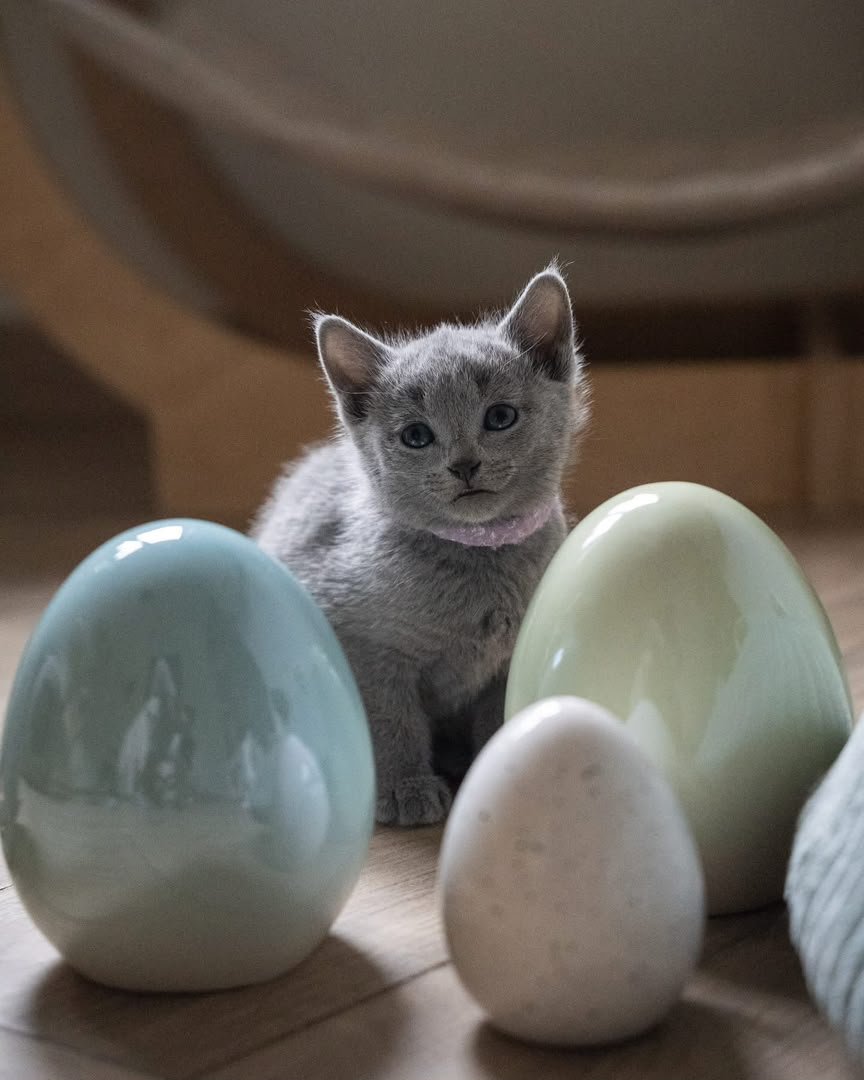
Green eyes are a distinctive feature of the adult Russian Blue. A kitten’s eye color develops as it grows, so early photographs do not necessarily show its eventual adult color. Development varies; we do not promise a particular change on an exact date.
The combination of their green eyes, wedge-shaped head and gently upturned mouth gives them the well-known “Russian smile” that so many people adore.
Russian Blues are elegant cats with a fine-boned appearance and a muscular body. Adult size varies between individuals. Your veterinarian can advise you about a healthy body condition rather than relying on one target weight for every cat.
| Size | Male: 9–10 lbs Female: 5–8 lbs |
|---|---|
| Coat Length | Short, dense, double coat |
| Coat Color | Blue (medium gray) with silver tipping |
| Eyes | Green (kittens born with blue eyes) |
| Pattern | Solid blue (ghost markings may be present in kittens) |
Russian Blues are sweet tempered, loyal, funny and very smart companions who will capture your heart. They are intelligent and can be trained quite easily. They are playful and loving, and some even learn to fetch and open doors.
Many form close bonds with familiar people while taking time to warm up to visitors. Individual personalities differ: we get to know each kitten rather than assuming that every Russian Blue will behave in the same way.
A Russian Blue is a good choice for the modern home. Their undemanding nature fits well with today’s busy schedules. They can entertain themselves if left alone for the day and be a contented companion when you return.
Great with children
when treated kindly
and with respect
Generally get along well
with dogs and other cats
when properly introduced.
Can be independent
during the day and happy
with companionship
in the evenings.
The Russian Blue requires a minimum of grooming. Their short, plush coat can be kept looking beautiful with frequent petting and an occasional combing. Regular nail clipping and routine veterinary care are recommended.
They enjoy a clean environment and will quickly let you know if their litter box does not meet their approval. Good nutrition, fresh water, toys and a comfortable home help them stay happy and healthy.
Welcoming a kitten is a commitment that continues into adulthood and senior life. Lifespan varies, and being a pedigree cat does not rule out illness. Regular veterinary care, appropriate nutrition and an attentive home matter throughout your cat’s life.
Prepare for daily life with your kitten and review our health preparation and written guarantee information.
Rumor has it that Russian Blues are hypoallergenic. That’s not the case. No cat breed is truly hypoallergenic. While Russian Blues are known for being low shedding, they still produce allergens. If you have cat allergies, we recommend learning more about the causes of feline allergies and speaking with a healthcare professional before adopting.
Russian Blues are, by their name, blue. We are proud to breed consistently blue, short hair cats with emerald green eyes. A Russian Blue of any other color or coat length is just not a CFA Russian Blue.
Our program is devoted to Russian Blues. We consider temperament and breed characteristics together, and our showing experience has been primarily in CFA with occasional TICA shows.
We do not work with cats other than pure Russian Blues in our breeding program, nor do we allow our cats to be used in a colored or longhair program. We feel this is the only way to ensure that our breeding cats continue to carry only the blue, shorthair genes for future generations.
Occasionally, a blue pointed kitten may appear in a litter. This is due to the use of a Blue Point Siamese during the breed’s recovery when the gene pool was smaller. These kittens are rare and are not registered as Russian Blues, nor are they used in our breeding program. They are always placed in loving forever homes.
If you are looking for an intelligent, affectionate, playful and loyal companion, a Russian Blue may be the perfect choice. They are best suited to families who can provide a loving home, gentle handling, regular play and companionship.
Ask who raises the kittens, how they are cared for, what veterinary documentation is supplied, and when they go home. Registered names and show titles should be supported by records, and a breed label should never replace a conversation about an individual kitten.
We are happy to explain our adoption journey and share the information relevant to the kitten you are considering.
At Valnika, we breed occasionally, with a love for this remarkable breed and a commitment to health, temperament and the classic beauty of the Russian Blue.
If you are interested in a Russian Blue kitten, we welcome thoughtful inquiries from families throughout Texas. Please take time to explore our available kittens or contact us to learn more about our future litters. Our next planned litter availability is January 2027. Contact us to confirm timing and availability.
Find answers to common questions about the Russian Blue’s history, appearance, personality, care and more.
View All FAQs →The Russian Blue is associated with northern Russia. Breeders in Scandinavia and Great Britain later helped develop the breed. Our history sections above explore its development.
Yes. Russian Blues shed, and the amount varies between cats and seasons. Gentle brushing helps remove loose hair and maintain their short, dense coats.
They can make lovely family companions. Gentle handling, quiet retreat spaces and gradual introductions help cats settle with children and other pets. Every kitten has its own temperament.
No. Their eye color develops as they grow; the green eyes associated with adult Russian Blues are not present at birth.
No cat breed is guaranteed hypoallergenic. Russian Blues produce allergens and can cause reactions. If your household has cat allergies, consult a qualified healthcare professional before adopting.
Lifespan varies between individual cats. Regular veterinary care, appropriate nutrition and a safe home support their wellbeing throughout life. Ask your veterinarian about care as your cat grows older.
A gray coat alone does not establish breed. Russian Blues have breed-specific characteristics and documented ancestry. Ask a breeder about the individual kitten and its pedigree.
Valnika is located in Carthage, Texas. Visit our Available Kittens page for individual profiles and current reservation status, or join our waiting list for a future litter.
The Russian Blue’s beauty, intelligence and affectionate nature make it a truly special companion. If you think this might be the perfect breed for your family, we would love to hear from you.